Counting Religion in Britain, August 2024

Counting Religion in Britain, No. 107, August 2024 features twelve short articles on new sources of British religious statistics. The contents list appears below and a PDF version of the full text can be downloaded from the following link No 107 August 2024

OPINION POLLS

  • Pew Research Center polling updates on religion
  • Church closure poll: Whitestone Insight for National Churches Trust
  • UK general election, 2024: how faith communities actually voted
  • Religion as a source of the current conflict in the Middle East: new YouGov poll
  • Public concerns about religious extremism in the UK: Ipsos and YouGov polling
  • Is the National Health Service treated like a ‘national religion’ in Britain?

FAITH ORGANIZATION STUDIES 

  • Public examinations in Religious Studies
  • UK general election, 2024: final briefing from Theos, on religion and climate change
  • JPR report on UK Jewish observance of Shabbat
  • Community Security Trust report on anti-Semitic incidents, January–June 2024
  • Foreign-born Jews resident in the UK: Pew Research Center stands corrected

ACADEMIC STUDIES

  • Some picks from recent Taylor and Francis academic journals

Please note: Counting Religion in Britain is © Clive D. Field, 2024

Posted in Attitudes towards Religion, church attendance, Ministry studies, News from religious organisations, Religion and Politics, religious festivals, Religious prejudice, Survey news | Tagged , , , , , , , , , , , , , , , , , , , , , , , , , , , , , , , , , , , , , , , , , , , , , , , , , , , , , , , , , , , , | Leave a comment

Counting Religion in Britain, June 2024

Counting Religion in Britain, No. 105, June 2024 features fourteen short articles on new sources of British religious statistics. The contents list appears below and a PDF version of the full text can be downloaded from the following link No 105 June 2024

OPINION POLLS

  • UK general election, 2024: Survation/Jewish Chronicle poll of Jewish voting intentions
  • UK general election, 2024: Savanta/Hyphen poll of Muslim voting intentions
  • UK general election, 2024: deselection of David Campanale as a LibDem candidate
  • Attitudes to faith in public life: another Institute for the Impact of Faith in Life poll

FAITH ORGANIZATION STUDIES

  • UK general election, 2024: more briefings from Theos
  • UK general election, 2024: briefings from the Religion Media Centre
  • UK general election, 2024: How might Jewish electors vote?
  • Voice for Justice UK report on The Costs of Keeping the Faith
  • General Synod paper: parlous state of Church of England diocesan finances
  • Fall-out from Israel-Hamas conflict: impact on the UK film and television workforce

OFFICIAL STATISTICS

  • Religious marriages in England and Wales, 2021 and 2022

ACADEMIC STUDIES

  • Churchgoing in Britain during the fin de siècle
  • Coronavirus chronicles: religious affiliation and Covid-19 vaccine uptake in England

NEW DATASET

  • Release of European Social Survey, round 11 data for the UK

Please note: Counting Religion in Britain is © Clive D. Field, 2024

Posted in church attendance, Covid-19, Historical studies, News from religious organisations, Official data, Religion and Politics, Religion in public debate, Religious prejudice, Rites of Passage, Survey news | Tagged , , , , , , , , , , , , , , , , , , , , , , , , , , , , , , , , , , , , , , , , , , , , , , , , , , , , , , , , , , , , , , , , , , , , , , , , , , , , , , | Leave a comment

Counting Religion in Britain, December 2019

Counting Religion in Britain, No. 51, December 2019 features 19 new sources of British religious statistics. The contents list appears below and a PDF version of the full text can be downloaded from the following link: No 51 December 2019

OPINION POLLS

  • Who doesn’t like Christmas? Some religious correlates from YouGov Profiles
  • Attitudes to Jews and Muslims: ICM Unlimited polling for Avaaz
  • Attitudes to Israel and the Middle East conflict: annual Populus/BICOM survey, 2019
  • Tottenham Hotspur Football Club’s fanbase consultation on the use of the Y-word
  • Autumn 2019 Eurobarometer: what value do we place on religion?

OPINION POLLS–2019 GENERAL ELECTION CAMPAIGN (PART 2)

  • Religion and party choice: Lord Ashcroft’s data on how people actually voted
  • Muslims and the general election: Savanta ComRes poll for Henry Jackson Society
  • Anti-Semitism as a general election issue for the Labour Party

FAITH ORGANIZATION STUDIES

  • Wellbeing and flourishing among Church of England clergy and ordinands

OFFICIAL AND QUASI-OFFICIAL STATISTICS

  • ONS Research Report on Population Estimates by Ethnic Group and Religion
  • UK Sikhs and the ethnicity question in the 2021 census of population
  • Religious profession of UK armed forces personnel: biannual update

ACADEMIC STUDIES

  • Religion and party choice: data from the British Election Study Internet Panel
  • Religion and party choice among Roman Catholics in 2017 and 2019
  • Pew Research Center on religion and living arrangements around the world
  • Religion and parental values: evidence from the Millennium Cohort Study
  • Muslim perceptions of Western hostility to Islam in 2011 and 2013
  • Annual update of BRIN source database for 2019

NEW DATASET

  • Pew Global Attitudes Survey, Spring 2018

Please note: Counting Religion in Britain is © Clive D. Field, 2019

Posted in Ministry studies, News from religious organisations, Official data, Religion and Ethnicity, Religion and Politics, Religion in public debate, Religious Census, religious festivals, Religious prejudice, Survey news | Tagged , , , , , , , , , , , , , , , , , , , , , , , , , , , , , , , , , , , , , , , , , , , , , , , , , , , , , , , , , , , , , , , , , , , , , , , , , , , , , , , , , , , , , , , , , , , , , , , , , , , , | 2 Comments

Counting Religion in Britain, November 2019

Counting Religion in Britain, No. 50, November 2019 features 23 new sources of British religious statistics. The contents list appears below and a PDF version of the full text can be downloaded from the following link: No 50 November 2019

OPINION POLLS

  • Attitudes to Christianity, faith, and Bible: Lumino website launched by Bible Society
  • Attitudes to right and wrong: Savanta ComRes poll on morality for the BBC
  • ADL Global 100: An Index of Anti-Semitism, 2019 update
  • Antisemitism Barometer, 2019 from the Campaign against Antisemitism
  • Muslim women and removal of the face veil
  • Trust in clergy and other professions: Ipsos MORI Veracity Index, 2019

OPINION POLLS–2019 GENERAL ELECTION CAMPAIGN

  • December 2019 general election: religion and voting intention
  • December 2019 general election: anti-Semitism and Islamophobia [9 polls]

FAITH ORGANIZATION STUDIES

  • Does the 2030 Future Have a Church? New e-book from Peter Brierley
  • Church of England cathedral statistics, 2018
  • Statistics of the Church of Jesus Christ of Latter-day Saints
  • British Muslims and the December 2019 general election

OFFICIAL AND QUASI-OFFICIAL STATISTICS

  • Crimes at churches and religious buildings, 2017–19: police data under FOI requests
  • Diversity reporting by Government departments and agencies

ACADEMIC STUDY

  • Periodizing secularization in modern British history

Please note: Counting Religion in Britain is © Clive D. Field, 2019

Posted in church attendance, Historical studies, Ministry studies, News from religious organisations, Official data, Religion and Ethnicity, Religion and Politics, Religion in public debate, Religious beliefs, Religious prejudice, Survey news | Tagged , , , , , , , , , , , , , , , , , , , , , , , , , , , , , , , , , , , , , , , , , , , , , , , , , , , , , , , , , , , , , , , , , , , , , , , , | Leave a comment

Counting Religion in Britain, February 2019

Counting Religion in Britain, No. 41, February 2019 features 20 new sources of British religious statistics. The contents list appears below and a PDF version of the full text can be downloaded from the following link: No 41 February 2019

OPINION POLLS

  • Multinational surveys of attitudes towards major world religions
  • Pew Global Attitudes Survey, 2018 – international concerns, including ISIS
  • Three surveys on consequences of the erosion of the ISIS caliphate
  • Hope Not Hate’s report on State of Hate, 2019
  • YouGov/Jewish Labour Movement survey of anti-Semitism and the Labour Party
  • Darwin Day poll – belief in evolution and knowledge of Charles Darwin
  • Religious affiliation
  • Londoners’ interactions with people from different backgrounds
  • Popularity of religious education and other subjects with older teenagers

FAITH ORGANIZATION STUDIES

  • Ozanne Foundation’s National Faith and Sexuality Survey, 2018
  • Women speakers on Christian conference platforms in 2018
  • Church Army Research Unit report on Messy Church
  • Census of Catholic schools and colleges in England and Wales
  • Projections of demand for places in state-funded Jewish secondary schools in London
  • Community Security Trust’s anti-Semitic incidents report, 2018
  • Anti-Semitism in the Labour Party

OFFICIAL AND QUASI-OFFICIAL STATISTICS

  • Latest Food Standards Agency statistics of ‘religious’ slaughter of animals

ACADEMIC STUDIES

  • Research in the Social Scientific Study of Religion
  • Ethnic minority voters in the 2015 general election
  • Emergence of the quantitative society – in the long eighteenth century

Please note: Counting Religion in Britain is © Clive D. Field, 2019


Posted in Historical studies, News from religious organisations, Official data, Religion and Ethnicity, Religion and Politics, Religion in public debate, Religious beliefs, Religious prejudice, Survey news | Tagged , , , , , , , , , , , , , , , , , , , , , , , , , , , , , , , , , , , , , , , , , , , , , , , , , , , , , , , , , , , , , , , , , , , , , , , , , , , , , , , | Leave a comment

Counting Religion in Britain, November 2017

Counting Religion in Britain, No. 26, November 2017 features 23 new sources. It can be read in full below. Alternatively, you can download the PDF version: No 26 November 2017

OPINION POLLS

Good life

What makes for a good life in the eyes of the public? GfK set out to find the answer to this question in a global poll conducted during summer 2017, for which 23,000 adults from 17 countries were interviewed online, including 2,175 in the UK. Respondents were given a list of 15 factors which might make for ‘the good life’ (specified as the life they would like to have) and asked to choose those which were most significant for them. The UK’s selection was headed by good health (82%), financial security (75%), and leisure time (68%), with spiritual enrichment in eleventh place, on 26%, compared with the multinational mean of 39% (the national peak being in Brazil at 47%). The importance attached to spiritual enrichment did not differ between the sexes in the UK, but it was surprisingly low for the over-60s (21%) and high among under-20s (30%). GfK’s press release, including a link from which to download a free copy of the full report on the survey, is at:

http://www.gfk.com/en-gb/insights/press-release/health-financial-security-and-free-time-are-top-factors-for-the-good-life-say-uk-consumers/

Royal family

The recent announcement that Prince Harry is to marry American actress Meghan Markle in 2018 prompted The Times to commission YouGov to repeat some of its standard questions about attitudes to the royal family, in an online poll of 1,575 Britons on 27-28 November 2017. The topics covered included reactions to a member of the royal family marrying a person from various backgrounds. Just over two-thirds (68%) deemed it acceptable for a member of the royal family to wed somebody of a different religion, which was three points less than in November 2016, with 16% opposed (among them 22% of Conservatives) and a further 16% unsure. This was a similar proportion as in favour of a member of the royal family marrying someone of a different ethnicity (69%). A blog about the survey, containing a link to the full data tables, is at: 

https://yougov.co.uk/news/2017/11/29/5-charts-british-reaction-prince-harrys-engagement/

Protection of churches

Notwithstanding low and declining church attendance, cathedrals and churches rank second only to castles in a list of ten categories of UK historic buildings which the public considers should be protected for future generations. Asked to identify the first, second, and third most important category, 69% in aggregate opted for castles, 60% for cathedrals and churches, and 49% for royal palaces. Support for cathedrals and churches varied by age, rising from 49% among under-35s to 74% for over-65s. Findings derive from a ComRes survey commissioned by the National Churches Trust, for which 2,062 adults were interviewed online on 21-22 June 2017. The data tables are at:  

http://www.comresglobal.com/wp-content/uploads/2017/11/National-Churches-Trust-Historic-Buildings-Survey.pdf

Trust in clergy

The latest annual Ipsos MORI Veracity Index, compiled from face-to-face interviews with 998 adults on 20-26 October 2017, has revealed clergy and priests to be the tenth most trusted of the 24 professions included on the list. Two-thirds (65%) of the public trusted them to tell the truth (four points less than in 2016 and twenty points lower than in 1983, when the index began), against 30% who did not trust them and 4% who were unsure. The net veracity score of +35% for clergy and priests was way behind that of nurses (+89%), doctors (+84%), and teachers and professors (+76% each). The most negative scores were for government ministers (-59%) and politicians generally (-63%). At present, topline results only are available at:

https://www.ipsos.com/ipsos-mori/en-uk/politicians-remain-least-trusted-profession-britain

Thought for the Day

Thought for the Day is a regular faith-based slot in BBC Radio 4’s flagship Today programme, broadcast continuously (under different titles) since 1939. Its appropriateness in a news and current affairs programme is periodically challenged, and it has recently come under attack from some of Today’s own presenters. This prompted YouGov to include a question in an app-based poll reported on 1 November 2017, the British public being divided between those who wanted Thought for the Day removed from the schedules (44%) and those wishing to retain it (47%), 9% being undecided. Topline results only are available at:   

https://yougov.co.uk/news/2017/11/01/are-modern-women-fragile-thought-day-facebook-list/

Religious education

YouGov ran an app-based poll on the back of news that schools in Staffordshire are to offer virtual tours of mosques after some parents refused to allow their children to visit them during school religious education trips. Three-fifths of respondents thought that parents should have the right to withdraw their children from school visits to certain places of worship while a third suggested they should not be allowed to do so. Topline results were posted on 16 November 2017 at:

https://yougov.co.uk/news/2017/11/16/information-war-between-west-and-russia-religious-/

Christmas

The vast majority of Britons (83%) still prefer to describe the period around 25 December as Christmas, according to an online poll of 3,372 adults taken by YouGov on 17 November 2017. The proportion was lowest among under-25s (76%), Scots (78%), and Scottish National Party supporters (72%). It peaked (at 95%) with UKIP voters. Another 5% of the whole sample opted for Xmas while 9% gave other answers. Results, with breaks by demographics, are at:

https://yougov.co.uk/opi/surveys/results#/survey/42e1403b-cb80-11e7-bdbe-dfebc9b5b055

Gender fluidity

In recent guidance issued to its own schools, the Church of England has stated that children should be free to try out ‘the many cloaks of identity’ without being labelled or bullied. This statement was approved of by 71% of respondents to an app-based poll by YouGov reported on 14 November 2017, with 21% disapproving and 7% unsure. Topline results only are at:

https://yougov.co.uk/news/2017/11/14/coes-statement-regarding-gender-traffic-lights-mot/

Sexual orientation and identity

The International Lesbian, Gay, Bisexual, Trans, and Intersex Association (ILGA) has released the results from the ILGA-RIWI Global Attitudes Survey on Sexual, Gender, and Sex Minorities, 2017, conducted in partnership with Viacom, Logo, and SAGE. Data were gathered, by means of opt-in online interviews, from 116,000 adults aged 18 and over in 75 countries plus Hong Kong and Taiwan. By virtue of the patented Random Domain Intercept Technology employed by RIWI, which targets web users bypassing search engines (see pp. 13-14 of the global report for a description of methodology), these do not comprise nationally representative samples. There were 6,483 respondents from the UK, although not everybody answered all the questions (partly because of the use of a combination of fixed and rotating modules).

Two statements with Likert-style answers specifically addressed religion. The first related to sexual orientation: ‘it is possible to respect my religion and be accepting of people who are romantically or sexually attracted to people of the same sex’, with which 58% in the UK agreed and 15% disagreed, 27% being neutral. The second statement concerned gender identity: ‘it is possible to respect my religion and be accepting of people who dress, act, or identify as one sex although they were born as another’, with which 59% in the UK agreed and 12% disagreed, 29% being neutral. The global report and country-specific data (in Word and Excel formats) can be downloaded from:

http://ilga.org/what-we-do/ilga-riwi-global-attitudes-survey/

Schoolchildren and the hijab

Ofsted, the Office for Standards in Education, Children’s Services and Skills in England, has recently recommended its inspectors to question Muslim primary school girls if they are found to be wearing a hijab, in order to ascertain whether they have been forced to do so. In response to a YouGov app-based poll whose results were posted on 21 November 2017, a plurality (47%) of Britons thought the school inspectors should not be interviewing hijab-wearing Muslim primary school girls in this way. Two-fifths considered they should be interviewed while 14% were uncertain. The topline findings only are available at:  

https://yougov.co.uk/news/2017/11/21/hijabs-schools-counter-terrorism-classes-poetry/

Islamic State

When they met in Vietnam recently, US President Donald Trump and Russian President Vladimir Putin resolved to defeat Islamic State in Syria. However, a plurality of Britons (43%) thinks they will fail in this goal, with 42% having confidence they will succeed and 15% unsure. The poll was conducted by Yougov’s app and reported on 13 November 2017 at:

https://yougov.co.uk/news/2017/11/13/trump-and-putin-vs-isis-next-conservative-leader-f/

FAITH ORGANIZATION STUDIES

Voting of churchgoers 

Christian Research has posted a summary of its online poll of 1,512 UK practising Christians (church leaders and churchgoers) conducted, during week-commencing 29 May 2017, in the immediate run-up to the 2017 general election. Respondents were drawn from the Resonate panel, which is self-selecting, and were disproportionately male, Anglican, Baptist, and Methodist. The overwhelming majority (96%) of practising Christians said they intended to vote in the election. Just 10% stated they always voted for the same political party. With only days to go, 24% had still not decided how to cast their vote. Of those who had already made up their minds, 37% opted for the Conservatives, 32% for Labour, and 22% for the Liberal Democrats (the last figure significantly above the national average, reflecting the legacy of Free Church electoral habits). Managing the National Health Service was the most important policy factor in determining voter preference, followed by Brexit and ensuring the benefits of economic growth were felt by all. The post is available at:

http://www.christian-research.org/reports/election-2012/

Church of England cathedral statistics

The 44–page Cathedral Statistics, 2016 reports on attendance at services (Sunday, midweek, and festival), rites of passage, visitors (9,030,000 plus 1,100,000 at Westminster Abbey), educational outreach, events, volunteers, choristers, and musicians. Ten years of trend data are included. The report is available on the recently revamped Church of England website at:

https://www.churchofengland.org/sites/default/files/2017-11/2016cathedralstatistics_0.pdf

In accordance with current fashion, the new Church website is mobile-friendly and shifts the emphasis in content away from words to images and sounds. To that end, a lot of documentation on the old website appears to have been dropped. Fortunately, the Research and Statistics pages have not been too adversely affected, but it would seem logical to complete the online back-file of Church Statistics and perhaps even to add digitized editions of the forerunner Statistical Supplement to the Church of England Yearbook. The Research and Statistics pages do serve an important archival function. They can be found at:

https://www.churchofengland.org/more/policy-and-thinking/research-and-statistics

Muslim marriages

A survey commissioned in connection with Channel 4’s The Truth about Muslim Marriage programme, broadcast on 21 November 2017, has revealed that 60% of Muslim women married in Britain (and 80% of those under 25) are not in legally recognized marriages. This is because they have not had a civil marriage ceremony alongside their traditional Islamic (Nikah) religious wedding. Many (28%) of these women who were just married religiously were unaware of the fact that, as a consequence, they did not have the same rights and protections afforded to couples marrying in the eyes of the law. Of the 66% who understood their marriage had no legal standing, half had no plans to enter into a civil wedding. The situation arises in part because only one in ten mosques in England and Wales is licensed for the solemnization of marriages and just 31% of Muslim women married in the UK had done so in a mosque.

The study also explored attitudes to polygamy, finding that 89% of the women did not wish to be in a polygamous relationship and that 37% of the 11% who were in such a relationship had not agreed to it.

The interviews, with 923 Muslim women married in Britain, were conducted, face-to-face or over the telephone, by female Muslim community researchers in 14 British cities in two waves between December 2016 and July 2017. Respondents were recruited by snowballing techniques and thus do not necessarily constitute a representative sample. Channel 4’s press release is at:

http://www.channel4.com/info/press/news/new-channel-4-survey-reveals-the-truth-about-muslim-marriage

Additional survey documentation, including the questionnaire for the second wave and a fuller description of methodology, is available on the website of True Vision Aire, the production company which made the programme, at:

http://truevisiontv.com/films/details/295/the-truth-about-muslim-marriage

OFFICIAL AND QUASI-OFFICIAL STATISTICS

Armed forces diversity statistics

The Government has published the UK armed forces biannual diversity statistics as at 1 October 2017. In respect of religion, they reveal that 72% of the Regular Forces and 74% of the so-called Future Reserves 2020 self-identified as Christian on that date with, respectively, 25% and 24% professing no religion, together with relatively small numbers of non-Christians. The proportion of religious nones in the Regular Forces continues to be highest in the Royal Navy (31%) and lowest in the Army (22%). The report and tables are at:

https://www.gov.uk/government/statistics/uk-armed-forces-biannual-diversity-statistics-2017

ACADEMIC STUDIES

European Social Survey

The first set of data from Round 8 of the European Social Survey has been released, including those for the UK, where 1,959 adults were interviewed face-to-face by NatCen Social Research between 1 September 2016 and 20 March 2017. This academically-led study, which has been conducted every two years since 2002, always includes a short module on religion, asking about religious affiliation, self-assessed religiosity (on a scale running from 0 = not at all religious to 10 = very religious), attendance at religious services other than rites of passage, and private prayer. The weighted results for Great Britain (excluding Northern Ireland) in 2002 and 2016 are shown in compressed form below, the biggest change being the 11-point increase in those self-identifying as non-religious. The figures have been calculated from the Centre for Comparative European Survey Data website at:

http://www.ccesd.ac.uk

%

2002

2016

Regard self as belonging to a particular religion
Yes

48.0

44.5

No

52.0

55.5

Self-assessed religiosity
Not religious (0-4)

48.0

58.8

Neutral (5)

17.8

11.4

Religious (6-10)

34.2

29.8

Attendance at religious services apart from rites of passage
Monthly or more

17.8

18.0

Less often

31.6

30.5

Never

50.7

51.5

Private prayer
Daily

18.5

17.0

Monthly

18.0

15.4

Less often

19.0

16.2

Never

44.4

51.3

Material security and religious practice

In a recent article in Journal of Religion in Europe (Vol. 10, No. 3, 2017, pp. 328-49), Ingrid Storm tests three hypotheses linking material security (as measured by household income) with attendance at religious services at least monthly. Using the British Household Panel Survey and UK Household Longitudinal Study datasets for 1991-2012, she found that increased income was weakly associated with declining religious attendance but that reductions in income did not significantly impact attendance. However, the data did suggest that religious attendance improved and maintained life satisfaction in the face of economic loss. Access options to the article, ‘Does Security Increase Secularity? Evidence from the British Household Panel Survey on the Relationship between Income and Religious Service Attendance’, are outlined at:

http://booksandjournals.brillonline.com/content/journals/10.1163/18748929-01003004

Church schools and religious diversity

Further findings from the Young People’s Attitudes to Religious Diversity Project in 2011-12 are presented by Leslie Francis, Andrew Village, Ursula McKenna, and Gemma Penny in ‘Freedom of Religion and Freedom of Religious Clothing and Symbols in School: Exploring the Impact of Church Schools in a Religiously Diverse Society’, in Religion and Civil Human Rights in Empirical Perspective, edited by Hans-Georg Ziebertz and Carl Sterkens (Cham: Springer, 2018), pp. 157-75. A sub-sample of 2,385 students aged 13-15 from schools in England, Wales, and London who identified as Christian or of no religion was used. The authors conclude that, after controlling for gender and individual differences in personality and religiosity, ‘schools with a religious character are a source neither for good nor for ill in terms of shaping student attitudes either toward freedom of religious clothing and symbols in school or toward religious diversity more generally assessed’. The chapter can be purchased from:

https://link.springer.com/chapter/10.1007/978-3-319-59285-5_7

Muslim identity

Data from the Young People’s Attitudes to Religious Diversity Project also form the basis of Leslie Francis and Ursula McKenna, ‘The Religious and Social Correlates of Muslim Identity: An Empirical Enquiry into Religification among Male Adolescents in the UK’, Oxford Review of Education, Vol. 43, No. 5, 2017, pp. 550-65. The authors compared the responses of 158 male students aged 13-15 who identified as Muslim with those of 1,932 male students with no religious affiliation, finding (not unexpectedly) that the former had a distinctive profile in terms of both religiosity (measured across eight themes) and social values (six themes concerning wellbeing and attitudes to cultural and religious diversity). The correlations are presented in 14 tables with commentary. Opportunities for further research into Muslim identity are identified in the form of improved sampling and an elaborated survey instrument. Access options to the article are outlined at:

http://www.tandfonline.com/doi/full/10.1080/03054985.2017.1352351

Muslim population

The number of Muslims in the UK is projected to grow from an estimated 4,130,000 in 2016 to between 6,560,000 and 13,480,000 in 2050, or from 6.3% to between 9.7% and 17.2% of the population. So suggests the Pew Research Center in its latest report, entitled Europe’s Growing Muslim Population. To arrive at these projections, Pew modelled three scenarios for net Muslim migration (the biggest single factor affecting the size of the Muslim community), depending upon whether it was zero, medium, or high.  The UK is currently the top destination in Europe for regular (non-refugee) Muslim migrants. Natural increase was also factored into the calculations, reflecting the fact that Muslims are disproportionately young and still have a higher fertility rate than non-Muslims in the UK (one more child on average). The report is available at:

http://www.pewforum.org/2017/11/29/europes-growing-muslim-population/

Islamophobia

Although racial boundaries between whites, blacks, and Asians have blurred in recent years, Muslims are widely singled out for negative attention by both white people and non-Muslim ethnic minorities in Britain, including a large number who do not express hostility to other ethnic groups. This is according to Ingrid Storm, Maria Sobolewska, and Robert Ford, ‘Is Ethnic Prejudice Declining in Britain? Change in Social Distance Attitudes among Ethnic Majority and Minority Britons’, British Journal of Sociology, Vol. 69, No. 3, September 2017, pp. 410-34. Their evidence concerning attitudes to Muslims derives from a measure of interpersonal social distance, specifically acceptance of an in-law from Muslim versus other ethnic backgrounds, contained in the 2013 British Social Attitudes Survey (for whites) and the 2010 Ethnic Minority British Election Survey. Access options to the article are outlined at:

http://onlinelibrary.wiley.com/doi/10.1111/1468-4446.12250/full

NEW DATASETS AT UK DATA SERVICE

SN 8280: Health Survey for England, 2015

The Health Survey for England, 2015 is the twenty-fifth in a series of annual studies designed to monitor trends in the nation’s health. It is commissioned by NHS Digital and conducted by NatCen Social Research and the Department of Epidemiology and Public Health at University College London. It is undertaken through a combination of face-to-face interview, self-completion questionnaire, and clinical and other measurements. A number of core health-related topics are explored each year with additional topics investigated on a more occasional basis (including several in 2015). A question ‘what is your religion or belief?’ was one of the background variables included in the self-completion booklets given to the 13,748 adults and children interviewed in 2015, with reply options of no religion, Roman Catholic, other Christian, Buddhist, Hindu, Jewish, Muslim, Sikh, and any other religion. This permits analysis of the religious correlates of particular health conditions and attitudes. For a full description of the dataset and background documentation, see the catalogue entry at:

https://discover.ukdataservice.ac.uk/catalogue/?sn=8280&type=Data%20catalogue

SN 8290: Scottish Health Survey, 2016

The Scottish Health Survey, 2016 is the twelfth in a series initiated in 1995. It was conducted by ScotCen Social Research on behalf of the Scottish Government, 4,323 adults aged 16 and over living in private households throughout Scotland being interviewed face-to-face between January 2016 and January 2017. A belonging form of question about religious affiliation was asked of all respondents, which can be used as a variable for analysing answers to all other questions, whether health-related or not. A catalogue description of the dataset, with links to documentation, is available at:

https://discover.ukdataservice.ac.uk/catalogue/?sn=8290&type=Data%20catalogue

Please note: Counting Religion in Britain is © Clive D. Field, 2017


Posted in church attendance, News from religious organisations, Official data, Religion and Ethnicity, Religion and Politics, Religious prejudice, Survey news | Tagged , , , , , , , , , , , , , , , , , , , , , , , , , , , , , , , , , , , , , , , , , , , , , , , , , , , , , , , , , , , , , , , , , , , , , , , , , , , , , , , , , | Leave a comment

Religious Affiliation and Party Choice at the 2017 General Election

This post looks at how religious groups voted in the June 2017 general election. As with previous BRIN posts on this topic, it uses data from the British Election Study. Specifically, it uses the 2017 post-election wave (number 13) of the British Election Study Internet Panel 2014-18. The fieldwork was conducted by YouGov between 9-23 June 2017. The survey has a sample size of 31,196. Theset data and accompanying documentation were obtained from the BES website. The data were weighted and analysed on a cross-sectional basis.

Figure 1 presents the breakdown of the vote at the June general election based on religious affiliation. It shows the proportions voting Conservative, Labour, or for other parties combined. The traditional support of Anglicans for the Conservative Party is reaffirmed (58% voted for the Tories compared to 28% for Labour). The distribution of the vote amongst Catholics further highlights the declining support they have given to Labour at recent general elections, given their historical tendency to vote for that party. In 2017, 42% of the Catholic vote went to Labour, just ahead of the 40% that went to the Conservative Party.

Amongst Methodists, Baptists and those who identified as Church of Scotland, pluralities supported the Conservative Party. Amongst other Christians, support for Labour eclipsed that for the Conservatives (42% versus 38%).

Muslims voted overwhelmingly for Labour, with 85% having preferred for Jeremy Corbyn’s party, and 11% supported the Conservatives. Majorities, albeit somewhat reduced, voted Labour at the 2005-2015 general elections. Amongst Jews, a strong majority expressed support for the Conservative Party (63%), with around a quarter (26%) saying they voted for Labour. This builds on the plurality support for the Conservative Party shown by Jewish voters at the 2005-2015 general elections. Labour also received a plurality of the vote amongst those belonging to other religions (48%) and those with no religious affiliation (47%). Amongst these two groups, the Conservative vote share was, respectively, 33% and 32%.


Figure 1 Voting at the 2017 general election by religious affiliation

Source: Author’s analysis of British Election Study Internet Panel 2014-2018, wave 13.


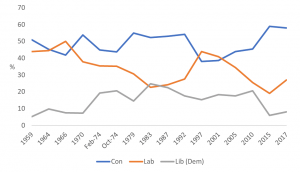
Putting the recent voting behaviour of Anglicans and Catholics in long-term perspective, Figure 2 and Figure 3 show the party vote shares amongst, respectively, Anglicans and Catholics between 1959 and 2017 (based on data from BES studies). Figure 2 shows the tendency of Anglicans to have expressed greater support for the Conservative Party at most post-war general elections.


Figure 2 Voting at general elections by Anglicans, 1959-2017Source: Author’s analysis of BES surveys.


Figure 3 shows the traditionally strong party-denominational links between the Catholic community and Labour. The higher levels of support amongst Catholics for Labour compared to the Conservatives (the exception is the 1979 election) are apparent, but support amongst has declined at recent elections. Support for the Conservatives has correspondingly increased at those elections.


Figure 3 Voting at general elections by Catholics, 1959-2017

Source: Author’s analysis of BES surveys.


Based on data from the BES and – where available – Scottish General Election Studies, Figure 4 shows that support for Labour has traditionally been considerably higher amongst Catholics in Scotland compared to those in England. However, in 2015, a ‘sea change’ general election in Scotland, there was a substantial drop in support for Labour amongst Catholics in Scotland. For the first time, in 2015, support for Labour amongst Catholics in England was slightly higher than that recorded in Scotland, and this was also the case in the 2017 general election (43% in England and 35% in Scotland). Though support for Labour was declining amongst Catholics in Scotland in the years prior to the 2015 election.


Figure 4 Vote share for Labour amongst Catholics in England and Scotland, 1970-2017

Source: Author’s analysis of BES and SGES surveys.

Reference
Fieldhouse, E., J. Green., G. Evans., H. Schmitt, C. van der Eijk, J. Mellon and C. Prosser (2017) British Election Study Internet Panel Wave 13. DOI: 10.15127/1.293723.

Posted in Religion and Politics, Religion in public debate, Survey news | Tagged , , , , , , , , , | 6 Comments

Counting Religion in Britain, June 2017

Counting Religion in Britain, No. 21, June 2017 features 23 new sources. It can be read in full below. Alternatively, you can download the PDF version: No 21 June 2017

OPINION POLLS

Religion and the general election

The actual political alignment of the principal religious groups at the general election held on 8 June 2017 was recorded by Lord Ashcroft in a poll of 14,384 electors who had voted by post or in person. Fieldwork was conducted in Britain (excluding Northern Ireland) on 6-9 June through a combination of telephone and online interviews. As the table below indicates, Christians were disproportionately likely to support the Conservatives, largely a function of the older age profile of Christians, while non-Christians and religious nones were inclined to favour Labour. The pro-Labour stance of non-Christians, which was far greater than in 2015, tracked the traditional pro-Labour allegiance of black and minority ethnic communities, albeit it was ten points less than the 2017 BME figure (as a consequence of the strongly pro-Conservative leanings of Jews). The pro-Labour stance of nones reflected their relative youth and Labour’s success in 2017 in reaching out to young people generally. The distribution of all votes is naturally affected by the collapse in UKIP support since 2015. A substantial minority of all the faith groups indicated that they had made up their minds about how to vote within a week of polling day: 33% of Christians, 38% of non-Christians, and 34% of nones. Data tables are available at:

http://lordashcroftpolls.com/wp-content/uploads/2017/06/GE-post-vote-poll-Full-tables.pdf

% down

All voters

Christians Non-Christians

Religious Nones

2017 general election
Conservative

41.3

51.5 27.7

29.4

Labour

39.1

31.2 56.8

47.6

Liberal Democrat

9.2

8.5 8.6

10.2

UKIP

2.9

3.1 1.2

2.9

Another party

7.4

5.7 5.6

9.9

2015 general election(recalled vote)
Conservative

37.0

44.9 30.2

26.8

Labour

30.6

26.3 42.6

35.0

Liberal Democrat

9.8

8.4 10.0

11.6

UKIP

12.3

13.8 7.6

11.0

Another party

10.4

6.7 9.7

15.6

Meanwhile, two pre-election polls by Opinium Research had investigated the voting intentions and attitudes to political issues of members of the UK’s black and ethnic minorities. Online fieldwork was conducted between 2 and 7 May and between 30 May and 1 June with, respectively, 511 and 607 respondents. The answers to all questions were disaggregated by religious affiliation, with the sub-samples of Christians (29% averaged across the two surveys), Muslims (28%), and religious nones (28%) being sufficiently large to be statistically robust. Full data tables can be accessed via the links in the blog post at:

http://opinium.co.uk/political-polling-ethnic-minorities-30th-may-2017/

Personal religious beliefs of politicians

One casualty of the 2017 general election was Tim Farron. Although re-elected to Parliament, he stood down as leader of the Liberal Democrats immediately afterwards, citing the difficulty of reconciling his Christian beliefs with serving as a political leader, his views on whether or not homosexuality is a sin having become a focus of the initial stages of the election campaign. Asked more generically, in an online poll by YouGov on 15 June 2017, about politicians who found their party’s ideology at odds with their personal religious views, 46% of the 5,526 Britons questioned felt that politicians should stay true to their religious convictions compared with 20% wanting them to privilege the party ideology (the remaining 34% were undecided). Conservatives (59%) and over-65s (62%) particularly wanted politicians to put their religion first, whereas 18-24s (26%) and Liberal Democrats (27%) placed above-average emphasis on fidelity to party ideology. Results are available at:

https://yougov.co.uk/opi/surveys/results#/survey/38a3a410-51ad-11e7-81f3-2ab0a50a8b9c

Forces for good

Lord Ashcroft’s poll covered a range of other political issues, the results for which were disaggregated by the three principal religious groups. The following table shows the proportion of each ranking, on a scale running from 0 to 10, certain trends as a force for ill (0-4), a mixed blessing (5), or a force for good (6-10). The higher the mean score, the more positive the group was towards the trend concerned. Reflecting their relatively elderly profile, Christians emerged as the community with the least progressive views, their conservatism exemplified in their disproportionate enthusiasm for capitalism. The internet was seen as the most positive development by all groups, albeit nones were also especially attracted to the green movement.

Mean scores

All voters

Christians Non-Christians

Religious Nones

Multiculturalism

5.42

4.92 6.51

5.93

Social liberalism

5.66

5.16 6.29

6.27

Feminism

6.37

6.01 6.39

6.87

Green movement

6.40

5.90 6.87

7.00

Globalization

5.46

5.41 5.82

5.47

Internet

7.03

6.92 7.22

7.17

Capitalism

5.35

5.61 5.21

5.02

Immigration

4.97

4.51 5.88

5.45

Religious affiliation

The most recent data on religious affiliation derive from an aggregate of five online Populus polls during May 2017 and the online component of Lord Ashcroft’s post-vote general election survey (noted above). The question was: ‘to which of the following religious groups do you consider yourself to be a member?’ Results are tabulated below.


%

Christian

52.3

Muslim

2.1

Hindu

0.6

Jew

0.7

Sikh

0.2

Buddhist

0.6

Other non-Christian

1.6

No religion

40.2

Prefer not to say

1.7

N =

23,477

Humanism

Marking its relaunch as Humanists UK, the British Humanist Association (BHA) has recently released the second tranche of findings from a survey it commissioned last year, for which 4,085 Britons aged 18 and over were interviewed online by YouGov on 28-29 July 2016. They revealed that 44% professed to belong to no religion, one-half being cradle nones and one-third raised as Anglicans. One-third of the whole sample met the BHA’s definition of being a humanist, as reflected in their selection of the humanist answer to three statement options (these answers were: ‘science and evidence provide the best way to understand the universe’; ‘what is right and wrong depends on the effects on people and the consequences for society and the world’; and ‘our empathy and compassion give an understanding of what is right and wrong’). The proportion meeting the definition varied significantly by age, from 46% of under-25s falling to 23% of over-55s. Of those fulfilling the criteria, 72% self-identified as humanists, 8% did not, with 19% uncertain. Interestingly, one-third of the sub-sample holding humanist beliefs actually claimed to belong to some religion, leading the BHA to conclude that 22% of the population are real humanists in (a) being non-religious and (b) subscribing to humanist beliefs. Full data tables can be accessed via the link in the press release at:

https://humanism.org.uk/2017/06/15/new-poll-shows-one-in-five-are-humanists-and-a-third-hold-humanist-beliefs/

God

One-half of adults either believe in God (17%) or some form of god or spirit (33%), according to an app-based survey by YouGov published on 15 June 2017. The plurality (45%) believes there is no kind of god or spirit, only the material world, while 5% venture other replies. Topline results are available at:

https://yougov.co.uk/news/2017/06/15/who-should-be-included-brexit-talks-god-vs-materia/

The same proportion of the population as believe in God or a spirit, 50% of 5,526 Britons interviewed online by YouGov on 15 June 2017, still consider it appropriate that the national anthem includes references to God, just 22% saying it is wrong (with 28% uncertain). The greatest level of support for the divine appearance in the national anthem is recorded among UKIP voters (67%), Conservatives (68%), and over-65s (69%), while Labour voters (33%), Scots (36%), and Scottish Nationalists (46%) are most inclined to think it wrong for God to be invoked in the national anthem. Results, disaggregated by standard demographics, are at:

https://yougov.co.uk/opi/surveys/results#/survey/38a3a410-51ad-11e7-81f3-2ab0a50a8b9c

Faith-based schools

Government plans to abolish the present cap preventing new faith-based schools from recruiting more than half their pupils on religious grounds find little favour with the electorate, according to a Populus poll on behalf of the Accord Coalition, for which 2,033 Britons were interviewed online on 5-7 May 2017. Forced to choose, four-fifths of respondents supported the status quo, including majorities of adherents of the two denominations (Church of England and Roman Catholic Church) which have the most faith schools. Just 20% in both Britain and England agreed that new state-funded faith schools should be allowed to select up to 100% of their pupils on the basis of faith, albeit this option appealed to 33% of Catholics and even higher proportions of the rather small numbers of Muslims and Jews in the sample. Full data tables are available at:

http://accordcoalition.org.uk/wp-content/uploads/2017/05/Religious-Schools-Survey.pdf

Inter-faith relations

A majority (53%) of young people aged 18-24 sense that religious intolerance in Britain has increased during the past five years, according to an online poll of 1,002 of them undertaken by ICM Unlimited on behalf of Hope Not Hate and the National Union of Teachers between 30 May and 1 June 2017. Just 18% thought religious intolerance was decreasing, with 13% detecting no change and 16% undecided. Asked about relations between particular faith communities, 30% assessed that Christians and Muslims do not get along with each other, compared with 33% saying the same about people of no faith and Muslims, and 19% about people with no faith and people with faith. Data tables are available at:

https://www.icmunlimited.com/wp-content/uploads/2017/06/2017_hopenothate_18-24s_poll.pdf

Attitudes to Islam

In an eight-nation study for Handelsblatt, undertaken online by YouGov between 21 May and 6 June 2017, a plurality (47%) of the 1,974 Britons interviewed detected a fundamental clash between Islam and the values of their society. This was much the same proportion as in the United States (45%) and France (48%), albeit it fell short of the majorities recorded in Germany (53%), Sweden (56%), Denmark (59%), Norway (59%), and Finland (60%). Just under one-quarter (23%) of Britons perceived Islam as generally compatible with British values, while 15% agreed with neither option and 16% did not know what to think. Topline results are available on p. 23 of the data tables at:

http://d25d2506sfb94s.cloudfront.net/cumulus_uploads/document/1eqs14w9mx/HandelsblattResults_Topline_May2017_tracked_W.pdf

Simultaneously, in YouGov’s app-based survey published on 21 June 2017, a majority of Britons acknowledged that British society was very (5%) or somewhat (54%) Islamophobic. A minority considered that it was not really (31%) or not at all (8%) Islamophobic. Topline results only are available at:

https://yougov.co.uk/news/2017/06/21/islamophobia-uk-brexit-talks-divorce-bill-and-futu/

Islamist terrorism

In the wake of the deadly Islamist attacks in Manchester on 22 May and London on 3 June 2017, 52% of Britons thought most British Muslim leaders could be doing a lot more to stop British Muslims being radicalized and to combat terrorism. The proportion was especially high among over-65s and Conservatives (66% each) and UKIP voters (76%). Just under one-third (29%) of the 2,130 adults interviewed online by YouGov for The Times on 5-7 June 2017 believed the Muslim leadership was doing all it reasonably could while 19% were unable to express an opinion. In a supplementary question, 7% of respondents claimed to have had difficult or embarrassing conversations with Muslim friends or colleagues in recent years on the subject of extremism or terrorism, and this was especially likely to have been the case in London (12%). Full data tables are available at:

https://d25d2506sfb94s.cloudfront.net/cumulus_uploads/document/d8zsb99eyd/TimesResults_FINAL%20CALL_GB_June2017_W.pdf

In a separate app-based poll by YouGov published on 6 June 2017, 75% of adults agreed that, in the light of recent terror attacks, Britain should be less tolerant of the rights of radical Islamists to express themselves. The topline result only is available at:

https://yougov.co.uk/news/2017/06/06/terrorism-and-general-election/

In the early hours of 19 June 2017, a van deliberately ploughed into worshippers who had just attended Ramadan prayers outside the Finsbury Park mosque in London, killing one person and injuring nine others. Eyewitness reports suggested that the van’s driver had vowed to kill Muslims. The authorities at the mosque criticized the media for initially failing to report the incident as terror-related. Quizzed online later the same day, 59% of 4,305 respondents to a YouGov app-based poll agreed that the attack outside the mosque could properly be described as an act of terrorism, with 23% dissenting and 18% uncertain. Results, with breaks by demographics, are available at:

https://yougov.co.uk/opi/surveys/results#/survey/75c6bfe0-54db-11e7-862a-1eb0da735179

Jewish opinions

In the May 2017 issue of Counting Religion in Britain, we reported on the initial results from a telephone poll of 515 self-identifying British Jews undertaken by Survation for the Jewish Chronicle on 21-26 May 2017. In its edition of 9 June 2017 (pp. 1-2), the newspaper headlined the findings from two additional questions. The first concerned the extent to which respondents were optimistic or pessimistic about the future of Jews in the UK; a plurality (47%) felt very or quite optimistic while 23% were pessimistic and 26% neutral on the subject. In the second question, the sample was asked whether they sensed that Israel was heading in the right or wrong direction under the leadership of its Prime Minister, Benjamin (‘Bibi’) Netanyahu; another plurality (41%) perceived the direction to be right against 33% saying it was wrong and 26% undecided. No data tables are in the public domain, as yet, but the newspaper’s coverage can be read at:

https://www.pressreader.com/uk/the-jewish-chronicle/20170609/281500751225361

FAITH ORGANIZATION STUDIES

Methodist statistics for mission

Methodist membership in Britain has declined by 3.5% year-on-year during the decade to 31 October 2016, now standing at 188,398, according to the Methodist Church’s latest triennial Statistics for Mission report. Net losses over the triennium were split between recruitment losses (55%) and retention losses (45%). Average weekly (Sunday and weekday) attendances at services are 202,100, only 14% of whom are by young people, with an estimated 500,000 individuals present at non-service activities. The 22-page report is available at:

http://www.methodist.org.uk/media/2625881/conf-2017-42-Statistics-for-Mission.pdf

Christians against Poverty

Christians against Poverty (CAP)’s Client Report for 2016 draws upon the charity’s client databases and 1,217 responses to its annual debt help survey, undertaken by post and online between September and November 2016. Low income is the most frequently-cited cause of debt, followed by relationship breakdown and mental ill-health. The mean annual household income of CAP’s new clients in 2016 was £14,700, a real-terms decrease on the 2015 figure, compared with the national average of £26,300. The overwhelming majority (89%) of clients had income below the national average and 63% were living below the poverty line. By the time they had sought CAP’s help, they had amassed outstanding debt balances equivalent to 97% of their annual income. The report can be downloaded from:

https://capuk.org/fileserver/downloads/policy_and_government/client_report.pdf

OFFICIAL AND QUASI-OFFICIAL STATISTICS

Armed forces diversity statistics

The proportion of UK service personnel professing no religion is continuing to grow steadily and, as at 1 April 2017, the proportion stood at just under one-quarter for both the regular forces and the reserves. In the case of regular forces, the figure was highest for the Royal Navy (30%) and lowest for the Army (21%). Further information is available in the Ministry of Defence’s latest biannual diversity statistics report at:

https://www.gov.uk/government/statistics/uk-armed-forces-biannual-diversity-statistics-2017

Religiously aggravated offending in Scotland

The number of charges relating to religious prejudice brought in Scotland in 2016-17 under the two relevant statutes was 719, representing an increase of 12% on the 642 in 2015-16. Roman Catholicism was the religion most often the subject of reported abuse, with 384 charges in 2016-17, 28% more than the year before, albeit not as high as in previous years. Charges related to Protestantism amounted to 165, to Islam 113, and to Judaism 23. Glasgow had the biggest concentration of charges (30%). The majority (91%) of all charges involved male accused. Full details are contained in the 24-page report by Rebecca Foster and Katherine Myant, Religiously Aggravated Offending in Scotland, 2016-17, which can be downloaded from:

https://beta.gov.scot/publications/religiously-aggravated-offending-scotland-2016-2017/

ACADEMIC STUDIES

British Social Attitudes Survey

NatCen Social Research has published the report on British Social Attitudes Survey, 34, which took place between July and November 2016. Interviews were achieved with 2,942 adults aged 18 and over, with some questions put to the full sample and others to part (one-third or two-thirds) samples. The standard questions on religious affiliation and attendance at religious services were included, the former revealing that 53% of respondents professed to belong to no religion, with 15% being Anglicans, 9% Roman Catholics, 17% other Christians, and 6% non-Christians. Other questions on religion do not appear to have been asked. Media coverage of the report has focused disproportionately on the chapter by Kirby Swales and Eleanor Attar Taylor (pp. 85-126) dealing with moral issues, notably on the continued growth in social liberalism with regard to pre-marital sex, same-sex relationships, abortion, and pornography (attitudes to euthanasia remain largely unchanged). This greater liberalism has been increasingly embraced by Christians, notably in terms of same-sex relationships, although across all the topics examined people with a religion were still less likely to hold liberal views than those with no religion (to a significant extent, this probably tracks the social conservatism of older people, who are disproportionately religious). These differences would doubtless be accentuated if only practising religious were considered; however, as the dataset from the survey has not yet been made available, this level of analysis cannot be undertaken at present. The remaining chapters concern tax and benefit manipulation, the role of government, civil liberties, Brexit, and immigration but have no religious content. The published report can be found at:

http://www.bsa.natcen.ac.uk/media/39196/bsa34_full-report_fin.pdf

European Social Survey

Since its inauguration in 2002, the European Social Survey (ESS) has proved a useful source of data on a limited range of religious topics across the twenty or so countries (including the United Kingdom) covered in each wave. Some of its potential in this regard is illustrated in three of the sixteen chapters in Values and Identities in Europe: Evidence from the European Social Survey, edited by Michael Breen (London: Routledge, 2017, xxv + 314 pp., ISBN: 978-1-138-22666-1, hardback, £110). One, by Ryan Cragun (pp. 17-35), is a case study of secularization in Ireland while the other two chapters focus on analyses at aggregate level of Round 6 of ESS (2012): Anna Kulkova, ‘Religiosity and Political Participation across Europe’ (pp. 36-57) and Caillin Reynolds, ‘Religion and Values in the ESS: Individual and Societal Effects’ (pp. 58-73). Few UK-specific statistics are cited. The book’s webpage is at:

https://www.routledge.com/Values-and-Identities-in-Europe-Evidence-from-the-European-Social-Survey/Breen/p/book/9781138226661

Anglican church growth

In ‘Intentionality, Numerical Growth, and the Rural Church’ (Rural Theology, Vol. 15, No. 1, 2017, pp. 2-11), David Voas revisits a survey he conducted in 2013 as part of the Church of England’s Church Growth Research Programme. This found no strong connection between numerical growth and worship style or theological tradition, the crucial factor being that congregations engage in reflection and make intentional choices about their future direction. The quantitative and qualitative evidence for that conclusion is summarized in this article and implications explored for rural churches, which are often conservative in character. To the extent that congregations are inward-looking, follow inherited practice, and resist change, Voas contends, it may be difficult for them to avoid stagnation or decline. Thus, the revitalization of tradition is a challenge for rural clergy and parishioners. Access options to the article are outlined at:

http://www.tandfonline.com/doi/full/10.1080/14704994.2017.1298265

Jewish vote

In two recent posts on his blog, University of Leicester academic Daniel Allington applies regression analysis to the results of the 2017 general election for the twenty British constituencies with the highest Jewish population at the 2011 census. He concludes that:

  • Many Jewish voters very probably turned away from the Labour Party between 2015 and 2017 (in the light of perceived anti-Semitism within the Party)
  • There is no indication that these lost voters switched to the Conservative Party in 2017
  • These voters seem rather more likely to have voted for the Liberal Democrats

The posts can be found at:

http://www.danielallington.net/2017/06/electoral-cost-left-wing-antisemitism/

http://www.danielallington.net/2017/06/jewish-voters-labour-conservative-liberal-democrat/

Roman Catholicism in the 1970s and 1980s

In a letter to The Tablet (10 June 2017, p. 17), sociologist of religion Mike Hornsby-Smith expressed concern about the long-term future of the archive of his quantitative and qualitative research into English Roman Catholicism in the 1970s and 1980s. This had led to countless published outputs, including two substantial books: Roman Catholics in England: Studies in Social Structure since the Second World War (1987) and Roman Catholic Beliefs in England: Customary Catholicism and Transformations of Religious Authority (1991). The archive had been deposited in the library of Heythrop College, part of the University of London. However, arising from financial challenges and following the failure of partnership discussions with, successively, St Mary’s University Twickenham and the University of Roehampton, the Jesuits in Britain have decided to close the College at the end of the 2017/18 academic year and have already sold the College buildings to a property developer. None of the College’s academic departments is relocating to another higher education institution and no firm plans are yet in place to secure the future of the College’s extensive and important library and archive, other than, in the short term, to pack it up and move it offsite somewhere. Hornsby-Smith has also deposited his own personal diaries, of a Catholic layman from the 1950s to the present, at the library.

Living by Numbers

The vital contribution which ideas of number, magnitude, and frequency make in shaping our everyday lives is rehearsed in Steven Connor, Living by Numbers: In Defence of Quantity (London: Reaktion Books, 2016, 296 pp., ISBN: 9781780236469, £15, hardback). The book’s webpage is at:

http://www.reaktionbooks.co.uk/display.asp?ISB=9781780236469&nat=false&stem=true&sf1=keyword&st1=Living%2Bby%2Bnumbers&m=2&dc=13

NEW DATASETS AT UK DATA SERVICE

SN 8165: Active People Survey, 2015-2016

The Active People Survey, inaugurated in 2005-06, is commissioned by Sport England to gauge participation in sport and active recreation. Wave 10, conducted by TNS BMRB between 1 October 2015 and 30 September 2016, achieved 164,458 telephone interviews with adults aged 14 and over throughout England. The demographic questions asked of a random 50% of respondents included two on religion: ‘what is you religion, even if you are not currently practising?’ and ‘do you consider that you are actively practising your religion?’ A catalogue description of the dataset is at:

https://discover.ukdataservice.ac.uk/catalogue/?sn=8165&type=Data%20catalogue

SN 8188: Scottish Social Attitudes Survey, 2015

The 2015 Scottish Social Attitudes Survey was undertaken by ScotCen Social Research, on behalf of the Scottish Government and other public sector funders, between July 2015 and January 2016. Face-to-face interviews and self-completion questionnaires were achieved with 1,288 adults aged 18 and over in Scotland. The survey instrument included a special module on discrimination and positive action, which had last been run in 2010, and which explored, among other things, opinions of religious groups in respect of long-term relationships, employment, and religious dress. Particular attention was paid to attitudes towards Muslims. Additionally, there were the standard background variables on religious affiliation and religion of upbringing and, for those with a religion, frequency of attendance at religious services or meetings other than for the rites of passage. A catalogue description of the dataset is at:

https://discover.ukdataservice.ac.uk/catalogue/?sn=8188&type=Data%20catalogue

A report on the discrimination module – Scottish Social Attitudes, 2015: Attitudes to Discrimination and Positive Action – was published by the Scottish Government in September 2016. This is separately available at:

http://www.ssa.natcen.ac.uk/media/38903/attitudes-to-discrimination-and-positive-action-2015.pdf

Please note: Counting Religion in Britain is © Clive D. Field, 2017

 

Posted in Attitudes towards Religion, Historical studies, News from religious organisations, Official data, Religion and Ethnicity, Religion and Politics, Religion and Social Capital, Religion in public debate, Religious beliefs, Religious prejudice, Survey news | Tagged , , , , , , , , , , , , , , , , , , , , , , , , , , , , , , , , , , , , , , , , , , , , , , , , , , , , , , , , , , , , , , , , , , , , , , , , , , | Leave a comment